In Canada, fleet operators tracking employees must disclose the practice in writing. Employers with 25 or more staff must have a written electronic monitoring policy. Under PIPEDA, express consent is required for location data collection. Covert GPS tracking of employees is prohibited. Limo Captain’s fleet tracking features are built for compliant Canadian operations.
Key Takeaways
• Ontario requires a written electronic monitoring policy for employers with 25 or more staff.
• PIPEDA requires express consent before an employer collects continuous GPS location data from employees.
• Installing a GPS tracker on a vehicle you do not own is illegal in Canada. Criminal charges can apply.
• GPS trackers can have battery lives of up to 3,000 days. This makes covert device detection genuinely difficult.
• PIPEDA requires express consent before GPS location data is used to evaluate employee performance. This is separate from the written monitoring policy requirement.
The Short Answer
Yes — operators in Canada can legally use GPS driver tracking on fleet vehicles. The one condition is disclosure.
In Canada, employers with 25 or more employees must have a written electronic monitoring policy. Under PIPEDA, they must obtain express consent before collecting GPS location data for performance evaluation. Provincial rules in BC, Quebec, and Alberta add further requirements.
Limo Captain’s fleet tracking features are designed to operate within these disclosure frameworks across North America.
How GPS Driver Tracking Works
A GPS device uses satellites to determine a vehicle’s position and speed. GPS devices transmit data using 4G or 5G cellular networks to a cloud server. Fleet managers view live vehicle locations on a digital dashboard.
Types of GPS Trackers
GPS driver tracking systems range from simple devices to comprehensive fleet management platforms. The main types in commercial use are:
• Hardwired trackers: permanently installed in the vehicle’s electrical system
• OBD-II trackers: plug-and-play devices that connect to the vehicle’s diagnostic port
• Magnetic trackers: mounted on any magnetic surface — battery-powered and removable
• Asset trackers: designed for non-powered assets but used in some fleet contexts
Real-time tracking typically requires a subscription service. GPS trackers can have battery lives of up to 3,000 days. Magnetic GPS trackers can be moved between vehicles — this creates particular legal complications.
What GPS Location Data Includes
GPS tracking data includes real-time position, speed, heading, and timestamp. Some GPS trackers offer geo-fencing that generates instant alerts when a vehicle leaves a defined zone. Telematics systems enhance driver safety by monitoring harsh braking, erratic driving, and rapid acceleration.
GPS accuracy is typically within 2 to 5 metres under open sky conditions. Encrypted data transmission protects location updates from interception. Real-time data from GPS tracking can provide accurate estimated arrival times for clients and dispatchers.
For a full breakdown of device types used in Canadian limo operations, see Best GPS tracker for fleet vehicles: guide for Canadian limo operators .
What the Rule Actually Says
No single statute governs GPS tracking across all of Canada. Three separate legal frameworks apply simultaneously: PIPEDA, provincial employment standards, and the Criminal Code.
Ontario’s Employment Standards Act, 2000, Part XI.2 (s. 41.1) requires employers with 25 or more employees to maintain a written electronic monitoring policy. Ontario Employment Standards Act — Electronic Monitoring
The Provision in Plain English
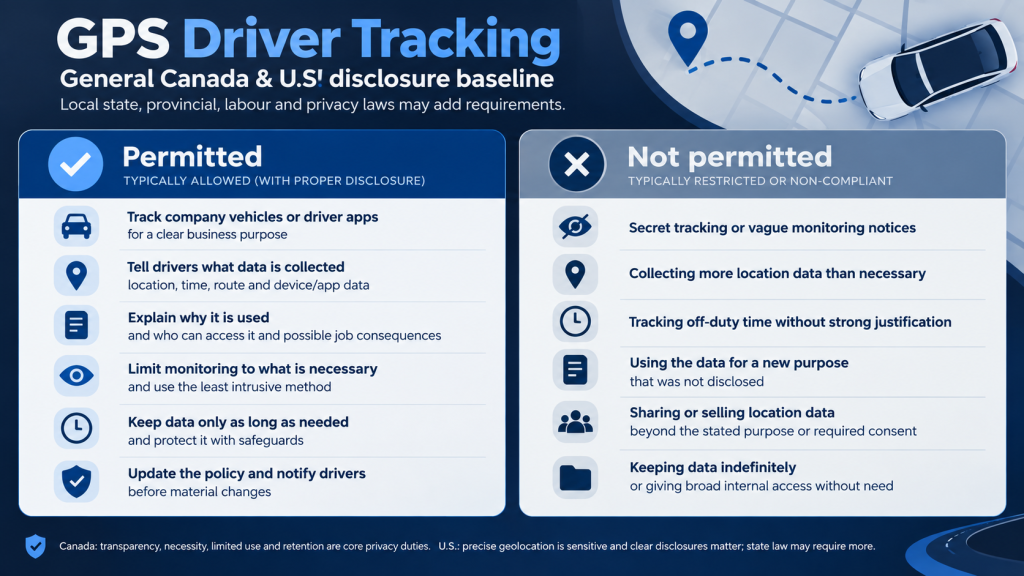
Ontario’s written policy must explain what electronic monitoring the employer uses. It must state how monitoring data will be used and whether third parties will receive it. It must identify the date the policy was prepared and the date of any amendments.
The policy must reach all employees within 30 calendar days of taking effect. New employees must receive it within 30 days of starting. The policy does not prohibit monitoring — it requires transparency about it.
PIPEDA applies nationally and is enforced by the Office of the Privacy Commissioner. PIPEDA — Personal Information Protection and Electronic Documents Act It requires express consent for collecting location data that can be used to evaluate employee performance.
What Is Covered or Permitted
Employers are permitted to:
• Track GPS location of company vehicles used by employees during work hours
• Monitor driving behaviour including speed, route, and idle time
• Use GPS data for dispatch, scheduling, and route optimization
• Store historical GPS data for compliance, safety, and incident review
• Share location updates with clients for accurate estimated arrival times
Employers can track their own vehicles for operational purposes. GPS tracking data must be tied to legitimate operational purposes under PIPEDA.
What Is Excluded
Employers are not permitted to:
• Track employee personal vehicles without express written consent
• Use GPS data to evaluate employee performance without separate consent under PIPEDA
• Collect GPS location data outside of working hours without clear justification
• Share GPS data with third parties not named in the written policy
• Use GPS tracking as the sole basis for disciplinary action without notice
Using GPS data to evaluate employee performance requires express consent. This is a common compliance gap for fleet operators.
The Exclusion People Trip Over
Many operators believe that GPS tracking of a company vehicle is automatically permitted. This is only partially correct. Tracking the vehicle’s location is permitted. Using that data to assess performance requires a separate express consent under PIPEDA. These are two different things.
How to Check Your Own Case
Start here: does a written electronic monitoring policy exist? If not, that is the first compliance gap — regardless of what else you are doing.
Canada: GPS Tracking Disclosure Requirements in Detail
PIPEDA and Location Data Consent
PIPEDA defines GPS location data as personal information. Collecting it requires identifying the purpose before or at the time of collection. Employers must obtain meaningful consent — implied consent is not sufficient for continuous location tracking.
The Office of the Privacy Commissioner of Canada has issued specific guidance on GPS tracking of employees. OPC Guidance on GPS Tracking It states that employers must be transparent about what data is collected and why.
Express consent is required for continuous GPS location tracking under PIPEDA. If GPS data use changes — from dispatch to performance evaluation — fresh consent is required.
Ontario Employment Standards Act — Written Policy Requirements
Ontario’s written electronic monitoring policy must be in place before tracking begins. It cannot be retroactive. The policy must cover all electronic monitoring: GPS tracking, email monitoring, and work-related mobile app tracking.
The ESA threshold is based on the employee count as of January 1. The written policy must be in place by March 1. Federally regulated employers in Ontario are also subject to Canada’s Privacy Act in addition to PIPEDA.
The policy does not cap what employers monitor. It caps what employers can do without notice. Transparency is the obligation — not limitation.
British Columbia, Quebec, and Alberta
British Columbia’s PIPA requires employers to disclose monitoring practices. No written policy is mandated, but a clearly communicated practice is required. The Office of the Information and Privacy Commissioner of BC enforces this.
Quebec’s Law 25 (Act Respecting the Protection of Personal Information) is stricter than PIPEDA. It requires express consent and a documented privacy policy accessible to employees. Non-compliance can result in significant administrative fines.
Alberta’s PIPA mirrors BC requirements. All three provinces require disclosure — the format differs.
Coverage Table: Jurisdiction by Disclosure Requirement

This table summarises disclosure requirements for fleet GPS tracking across major North American jurisdictions. Verify current requirements with qualified legal counsel before implementing any tracking programme.
| Jurisdiction | Disclose? | Written Policy? | Threshold | Key Law |
| Canada (PIPEDA) | Yes — express consent | No fixed format | All employees | PIPEDA s. 4.3 |
| Ontario | Yes | Yes — written | 25+ employees | ESA 2000 s. 41.1 |
| British Columbia | Yes | Recommended | All employees | BC PIPA |
| Quebec | Yes | Yes | All employees | Law 25 / Que. Privacy |
| Alberta | Yes | Recommended | All employees | AB PIPA |
Note: This table is for general information only. Laws change. Confirm current requirements in each jurisdiction with a qualified legal adviser.
Exceptions and Edge Cases
Tracking Someone Else’s Car
Installing a GPS tracker on a vehicle you do not own is illegal in Canada. In Ontario, installing a tracker without consent can result in criminal mischief charges.
This applies regardless of the relationship. Tracking an ex-partner’s or co-worker’s personal vehicle without consent can constitute stalking-adjacent conduct under Canadian law. Licensed investigators operate under specific court-ordered exceptions.
The Criminal Code provisions on tracking devices are found in Part XV. Criminal Code of Canada They set out strict conditions under which law enforcement can use tracking devices — conditions that do not apply to private employers.
Licensed Private Investigators
Licensed private investigators in Canada can lawfully conduct location tracking under provincial PI licensing acts. They must operate within the bounds of their licence and applicable court orders.
A licensed PI cannot install a tracker on another person’s vehicle without a court order. Their licence permits physical surveillance — it does not override consent requirements for device installation.
Criminal Code Implications for Employers
The Criminal Code of Canada contains provisions against wilful interference with property (s. 430) and against certain surveillance without consent. An employer who tracks an employee’s personal vehicle without consent risks criminal mischief charges.
Courts ask: would a reasonable person expect to be tracked in this context? Fleet vehicles operated during work hours generally meet this test. Personal vehicles do not.
Practical GPS Tracking Compliance for Fleet Operators
Compliance is not a single document. It is an ongoing practice. Fleet operators using GPS driver tracking should maintain four core habits.
Keep Your Written Policy Current
The written electronic monitoring policy is a living document. Update it when new tracking tools are added. Update it when you change how you use GPS data. Update it when employee headcount crosses the 25-employee threshold in Ontario.
An outdated policy is treated the same as no policy by employment standards enforcement. Review and sign off on the policy at least once per year.
Train Dispatchers and Fleet Managers
Everyone who accesses GPS data daily must understand what they can and cannot do with it. Real-time GPS tracking helps dispatchers re-route drivers around traffic congestion. That is a permitted operational use.
Using the same location data to build a performance review dossier without separate consent is not. Train your team on the difference. Document the training.
Manage Data Retention and Access
GPS location data should not be retained indefinitely. Set a data retention period and enforce it. Encrypted data transmission protects location updates in transit. Encrypted storage protects it at rest.
Limit access to GPS data to employees who need it for their role. Fleet managers, dispatchers, and safety officers typically qualify. HR reviewing performance generally requires additional consent.
Document Consent Separately From Employment Contracts
Express consent for GPS tracking should not be buried in an employment contract. It should be a standalone document. The purpose must be stated clearly. The employee must sign it.
If GPS data is used beyond its stated purposes, fresh consent is required. Location history from GPS can aid in investigating customer complaints and incidents. That is a permitted purpose if it was stated at the time of consent.
What to Do Next in North America
Canadian fleet operators with 25 or more staff should complete three steps before the next payroll:
• Draft or update a written electronic monitoring policy that names GPS tracking explicitly
• Distribute the policy to all employees and retain signed acknowledgements
• Obtain separate express consent under PIPEDA if GPS data will be used to evaluate performance
Operators in provinces other than Ontario should confirm requirements under BC PIPA, Quebec Law 25, or Alberta PIPA. Written disclosure is the safe standard in every Canadian jurisdiction.
Limo Captain’s fleet tracking features include built-in disclosure documentation templates and consent management for North American operators. The platform is configured to support compliant GPS driver tracking from day 1.
Legal advice specific to your jurisdiction is essential. This is general information — not a substitute for advice specific to your facts and jurisdiction.

Frequently Asked Questions
The questions below reflect common searches from North American fleet operators and business owners.
Is GPS Tracking of Employees Legal in Canada?
Yes, with disclosure. Employers are permitted to use GPS driver tracking on company vehicles. Ontario employers with 25 or more employees must maintain a written electronic monitoring policy. Under PIPEDA, express consent is required if GPS data is used to evaluate employee performance. Tracking without disclosure violates both provincial employment standards and federal privacy law.
Do Employers Have to Tell Employees About GPS Tracking?
Yes. Ontario employers with 25 or more staff must have a written electronic monitoring policy and distribute it to all employees. In BC, Quebec, and Alberta, disclosure is required under provincial privacy law even without a mandatory written format. PIPEDA applies nationwide and requires meaningful consent for location data collection.
Can I Install a GPS Tracker on a Fleet Vehicle Without Telling the Driver?
You can install a GPS tracker on a company-owned vehicle. However, Ontario’s Employment Standards Act requires that employees be informed through a written monitoring policy. PIPEDA requires consent if the tracking data will be used for performance evaluation. Undisclosed tracking creates legal and employment relations risk in every Canadian jurisdiction.
What Happens if I Track a Vehicle I Do Not Own?
Tracking a vehicle you do not own is illegal in Canada. Installing a GPS tracker on another person’s vehicle without consent can lead to criminal mischief charges. This covers employee personal vehicles, other businesses’ vehicles, and any vehicle not registered to your company. Consent is always required.
For more on how GPS tracking integrates with fleet dispatch systems, see How does real time driver tracking work .
About Limo Captain
Limo Captain is GPS-enabled limo dispatch software serving limousine operators across North America. The platform integrates real-time GPS tracking, automated dispatch, driver management, and fleet reporting in one system.
Limo Captain’s fleet tracking features are built for compliant operation in both Canadian and US jurisdictions. The platform supports written disclosure policy management, driver consent documentation, and configurable data retention settings.
For operators evaluating real-time GPS tracking options, real time GPS tracking with Limo Captain covers the platform’s tracking capabilities in detail.
For an overview of how driver tracking connects to dispatch workflows, see real time tracking driver .
Service Area
Limo Captain serves fleet operators across Canada. Primary markets include Toronto, Vancouver, Calgary, Edmonton, Ottawa, Montreal, and surrounding areas. The platform is configured for Canadian privacy law requirements and applicable provincial employment standards.
The platform supports North American payment networks, Canadian privacy law, and US state-level monitoring requirements.
Next Step
Ready to implement compliant GPS driver tracking for your fleet? Start with Limo Captain’s fleet tracking features — built for North American compliance. Book a free demo today. Call us: +1 888-545-8881