By the Limo Captain Editorial Team | August 2026 | Category: Limo Business Growth | Limo Captain Blog
Key Takeaways
• Commission links chauffeur earnings to completed bookings or trip revenue.
• Hourly pay provides greater income stability for predictable schedules.
• “1099” is a US tax term — Canada uses employee vs self-employed classification instead.
• Canadian employment status depends on the actual working relationship, not the contract label.
• Pay structure should match scheduling patterns, trip volume, and business needs.
• Capital gains taxes apply to capital property dispositions — not ordinary chauffeur wages.
Chauffeur Pay Models Explained: Commission, Hourly, and Independent Contracting
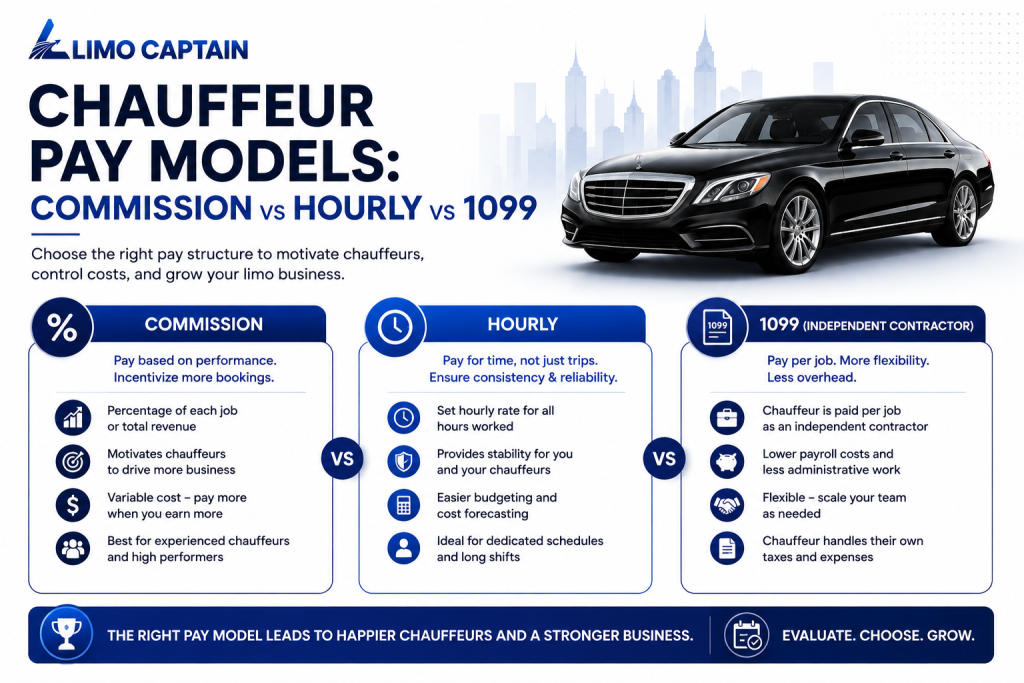
Chauffeur pay models determine how a driver earns compensation for transportation services. Each structure carries different income patterns, costs, and legal implications.
A note on the title: “1099” is a US tax classification. It does not exist in Canadian employment law. In Canada, the equivalent distinction is employee versus self-employed worker. This guide uses Canadian terminology throughout.
The right pay model depends on employment status, trip volume, scheduling, and business structure. Understanding each model helps limo companies and chauffeurs make informed decisions.
What Are Chauffeur Pay Models?
Chauffeur pay models describe how a driver receives compensation. A chauffeur can be paid hourly, per trip, or through commission. Compensation varies widely by employer type, driver classification, and geographic market.
CRA confirms that commission payments can apply to employees or self-employed workers. Canada Revenue Agency — Commission Payments Payroll deductions and tax reporting differ accordingly.
Commission-Based Chauffeur Pay
Commission-based pay connects compensation to bookings, sales, or completed trips. The chauffeur receives an agreed percentage or fixed amount per transaction. Commission-based pay is common in chauffeur services, and some operators add bonuses for high performance.
How Commission Pay Works
A company calculates commission from eligible trip revenue. The agreement should define the calculation method and when commission becomes payable. This reduces disputes over cancellations, refunds, and gratuities.
Commission Advantages and Challenges
Commission provides stronger earning potential during busy periods. It connects driver earnings with business performance. However, income can fluctuate when bookings drop. Chauffeurs need clear rules around cancelled or reassigned trips.
CRA distinguishes employee commission payments from self-employed compensation for payroll purposes. Canada Revenue Agency — Commission Payments
Hourly Chauffeur Pay
Hourly pay compensates a chauffeur according to eligible working time. Hourly pay provides stable income but limits earning potential during peak periods. This model works best when scheduled hours are consistent.
Benefits of Hourly Pay
Hourly pay can make budgeting easier for drivers. It also helps companies plan labour costs around scheduled shifts. Some employers use base salary plus gratuity. This creates stable base income with potential bonuses from clients.
Chauffeurs with specialized licences command higher pay due to their qualifications. This can be built into an hourly rate more easily than into a per-trip commission.
Overtime and Irregular Hours
Irregular hours and on-call status can drive up required compensation for chauffeurs. Overtime rules depend on applicable employment standards legislation.
Ontario provides overtime protections for eligible employees covered by the Employment Standards Act.
Federally regulated employees have specific overtime rules under federal labour standards. Government of Canada — Hours of Work Companies should review which rules apply to their specific workforce.
Independent Contractor vs 1099: What It Means in Canada

“1099” is a US tax document used for non-employee income. It is not a Canadian employment category.
In Canada, the distinction is between employee and self-employed worker. CRA says employees generally work under direction and control. Self-employed workers operate their own businesses.
CRA’s guidance on employment status covers the key factors used to determine the correct classification. Canada Revenue Agency — Employee or Self-Employed? A contract label alone does not decide the classification.
Independent contractors often face higher expenses which reduce net earnings even when gross revenue is high. Those costs can include vehicle maintenance, insurance, fuel, and licensing.
Chauffeur Pay and Operating Costs
Compensation should be evaluated against the costs required to perform the work. In Canada, employees may have statutory protections that independent contractors do not.
CRA identifies operating expenses and motor vehicle costs that may qualify for business deductions. Canada Revenue Agency — Types of Operating Expenses The business-use portion must be supported by appropriate records.
Chauffeur Pay and Employment Status
The payment method alone does not determine employment status. A driver can receive commission while still being an employee. CRA considers the complete working relationship.
Workers unsure about their status can request a CPP/EI ruling from CRA. Canada Revenue Agency — Employee or Self-Employed?
Do Capital Gains Taxes Apply to Chauffeur Pay?
Capital gains taxes apply to disposing of capital property. They do not apply to ordinary chauffeur wages. A chauffeur’s regular pay is employment income or business income, not a capital gain.
Capital gains could arise if a chauffeur sold a business vehicle or other capital asset. Day-to-day wages — commission, hourly, or contractor fees — are not subject to capital gains rules.
CRA uses Schedule 3 to calculate and report capital gains and losses from property dispositions. Canada Revenue Agency — Completing Schedule 3 Ordinary chauffeur compensation should be reported as employment or business income — not on Schedule 3.
Cost basis (adjusted cost base in Canadian terminology) applies to calculating gains from selling capital property. It does not determine wages or commission rates.
Comparing the Three Chauffeur Pay Models
| Factor | Commission | Hourly | Independent Contractor |
| Income stability | Variable | Higher | Variable |
| Earning upside | High in demand periods | More limited | Potentially high |
| Cost responsibility | Depends on agreement | Usually employer-led | Often higher |
| Overtime rules | Depends on status | ESA or federal | Generally excluded |
| Business risk | Shared | More employer-side | More worker-side |
| Best fit | Revenue-driven ops | Predictable schedules | Genuine independent businesses |
This table is a planning framework — not a legal classification test. Actual classification depends on the working relationship and applicable law.
Which Chauffeur Pay Model Fits a Limo Company?
There is no universal best model. High-volume operations may prefer structures that connect pay with trip production. Companies with predictable shifts may prefer hourly compensation.
Businesses using genuine independent operators may use contractor arrangements. Geographic location affects compensation levels — especially in metropolitan markets where demand is higher.
The important issue is matching compensation with operational reality. The chosen model should be practical, transparent, and compliant with applicable employment law.
How Limo Software Supports Chauffeur Pay Management
Limo software tracks trips, hours, drivers, commissions, and payments in one place. For commission models, accurate trip data helps calculate agreed payments. For hourly models, time records support payroll. The software should support the chosen compensation structure.

Why Clear Compensation Rules Matter
Every compensation plan should define how payment works. The agreement should address trips, cancellations, waiting time, gratuity, overtime, bonuses, and payment timing.
Clear rules help drivers understand expected earnings. They also help companies maintain consistent payroll or contractor records.
CRA requires employers to meet applicable reporting and withholding responsibilities for employees. Canada Revenue Agency — Commission Payments
Frequently Asked Questions
Which Chauffeur Pay Models Work Best for Limo Companies?
The best chauffeur pay models depend on scheduling, trip volume, and employment status. Commission suits revenue-driven operations. Hourly pay suits predictable shifts. Independent contracting suits genuine independent businesses. Companies should evaluate total compensation, operating costs, and applicable employment rules before choosing a structure.
Do Capital Gains Taxes Apply to Chauffeur Earnings?
Capital gains taxes do not normally apply to ordinary chauffeur earnings. Employment and business income are taxed separately from gains on capital property. Capital gains could arise if a chauffeur sells a business vehicle. Day-to-day wages are not capital gains. CRA uses Schedule 3 to report capital gains from property dispositions.
How Does Chauffeur Income Appear on a Tax Return?
How chauffeur income appears on a tax return depends on employment status. Employees report employment income on their T1. Self-employed workers report business income and may deduct eligible business expenses. CRA states that employment status affects reporting, CPP, and EI responsibilities. Workers unsure of their status can request a ruling from CRA.
Does Cost Basis Affect Chauffeur Compensation Calculations?
Adjusted cost base is the Canadian term for cost basis. It applies to calculating gains or losses from selling capital property. It does not determine wages, commissions, or trip payments. Cost basis becomes relevant if a chauffeur sells a vehicle or other business asset. Ordinary chauffeur compensation should be reported as employment or business income on the tax return.
How Does Short-Term Work Affect Chauffeur Pay Classification?
Short-term work does not automatically create a particular pay model or worker classification. A chauffeur may be paid hourly, per trip, or through commission regardless of contract duration. Worker classification depends on the actual working relationship. The payment label alone does not establish independent contractor status under Canadian rules.
Final Thoughts
Choosing between commission, hourly, and independent contractor pay requires more than comparing gross rates. Consider scheduling, trip volume, operating costs, worker classification, and payroll responsibilities. Clear rules protect both the driver and the business.
Limo Captain helps transportation companies manage bookings, drivers, dispatch, payments, and operational data in one platform.
Ready to make chauffeur compensation easier to manage?
📞 Call us today: +1 888-545-8881