Artificial intelligence can automate significant parts of what a limo dispatcher does — processing bookings, assigning drivers, sending notifications, and flagging schedule conflicts — but it cannot replace the judgment, relationship management, and real-time problem solving that experienced human dispatchers bring to the moments that matter most. The question is which parts generative AI tools does better than a human and which parts still require a person with knowledge, context, and sound decision making under pressure. Also,AI algorithms are inherently unexplainable in deep learning.
This guide examines what artificial intelligence ai actually is, what tasks AI tools can realistically automate for limo companies, where AI falls short of human dispatcher capabilities, and how Limo Captain uses automation to reduce workload without replacing the judgment that premium chauffeur service depends on. Will AI replace human intelligence? Let’s see…
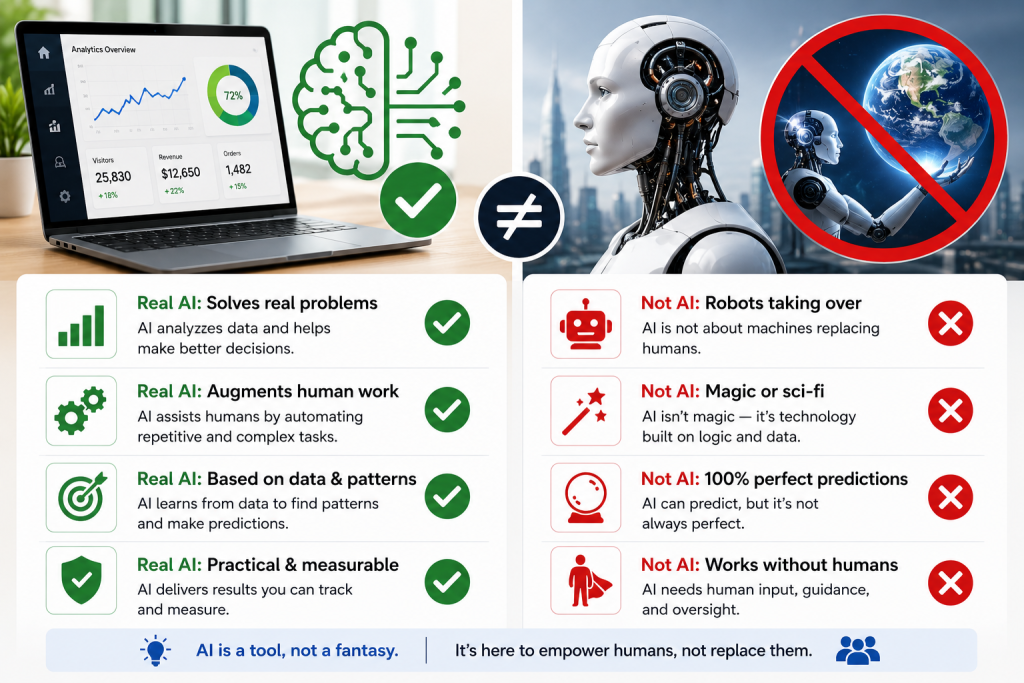
What Artificial Intelligence Actually Is — and Is Not
Artificial intelligence is a branch of computer science focused on building computer systems that can perform tasks requiring human intellect — reasoning, problem solving, learning from data, and understanding natural language. Coined by John McCarthy in 1956, the field has evolved from rule-based programs into systems that use machine learning and deep learning to analyze vast amounts of data and identify complex patterns without being explicitly programmed.
The AI tools most people encounter today are Narrow AI — systems designed for specific tasks that cannot operate outside their programmed domain. This is fundamentally different from Artificial General Intelligence, which would possess cognitive abilities similar to a human brain across complex tasks. AGI remains theoretical — ai researchers have not yet achieved it.
Current AI systems are powerful for repetitive tasks, analyzing data, and operating continuously without breaks — but they lack the self awareness, contextual judgment, and understanding of human relationships that define the highest-value aspects of dispatcher work.
The Main Types of AI Relevant to Limo Dispatch
Machine learning models improve performance on tasks automatically by learning from training data — identifying patterns in historical bookings to predict demand, optimise driver assignment, and flag conflicts before they occur. Machine learning models can also predict equipment failures before they occur, with direct application to fleet management.
Natural language processing enables AI to understand and generate human language — powering chatbots that handle booking enquiries, automated notification systems, and voice assistants that accept trip requests without human involvement. Deep learning uses multilayered artificial neural network architectures to handle complex tasks like understanding ambiguous customer requests.
Generative AI creates new content from learned patterns — text, scheduling recommendations, and automated responses. In 2023, GPT models achieved human-level scores on standardised tests. Agentic AI goes further: AI agents can autonomously observe and act to achieve complex goals without human intervention, capabilities now appearing in dispatch and fleet management software.
Current AI in limo dispatch is Narrow AI — powerful at specific tasks like route optimisation, automated notifications, and scheduling conflict detection. It is not Artificial General Intelligence. The moments that define premium service — a driver stuck in unexpected traffic, an anxious VIP client calling with a last-minute change, a wedding booking where everything has to be right — still require a human dispatcher.
What AI Can Realistically Automate in Limo Dispatch
AI can automate routine, repetitive tasks in limo dispatch — time-consuming, rule-based work that does not require contextual judgment, representing a significant portion of daily dispatcher activity.
Booking Processing and Scheduling
AI receives and processes booking requests from multiple channels simultaneously — website forms, passenger apps, email, and phone via natural language processing — without a dispatcher manually entering each booking. Automated booking engines accept reservations, apply pricing rules, generate confirmations, and populate the dispatch queue without human involvement.
Driver Assignment and Route Optimisation
AI automates driver assignment by matching bookings to available drivers based on vehicle type, location, and schedule data. AI-powered route optimisation calculates efficient routes from live traffic conditions — the same deep learning and computer vision technologies that power self driving cars and autonomous vehicles.
Real-time tracking allows AI to monitor the entire fleet and reassign drivers automatically when delays occur. When conditions are routine and data is complete, AI handles multi-variable decision making faster and with fewer errors than a human managing many layers of information simultaneously.
Customer Communication and Notifications
AI-powered chatbots provide 24/7 customer support — answering booking enquiries, providing ride status updates, and handling standard change requests without dispatcher involvement. Automated notifications keep customers informed at every trip stage. AI reduces human errors in routine communication by handling repetitive tasks systematically every time.
Analytics and Performance Reporting
AI analyzes large amounts of data to surface patterns in fleet utilisation, booking trends, driver performance, and revenue — giving management the data-driven insights to optimise operations and respond to market changes. AI enhances decision making across the business, from marketing campaigns to hiring decisions to fleet investment.
Where AI Falls Short of a Human Dispatcher
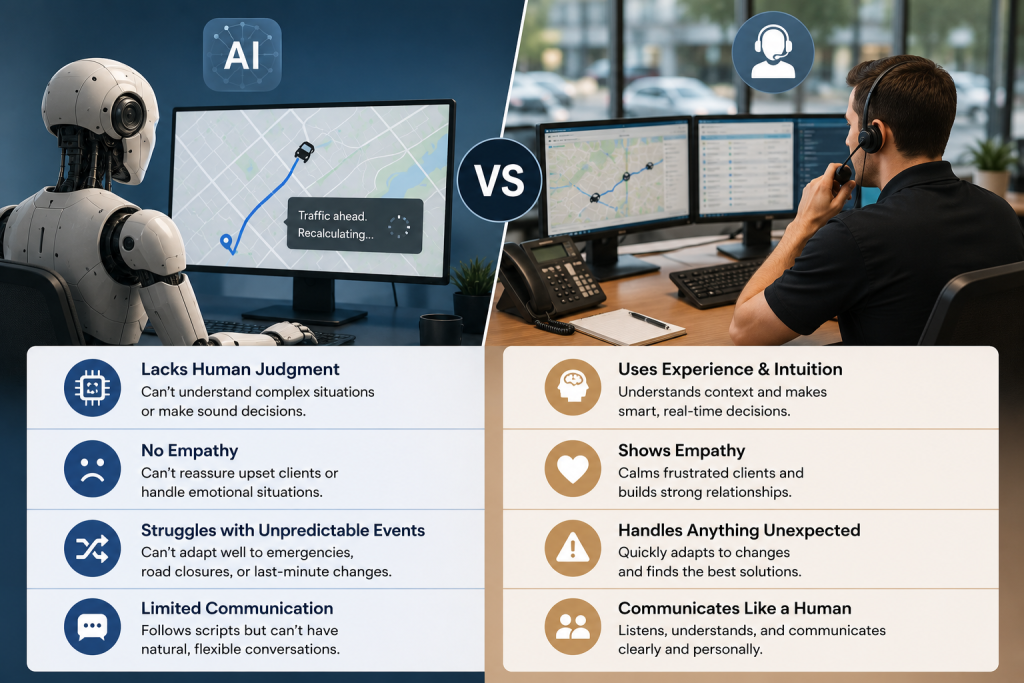
AI performs well on tasks that are rules-based, data-rich, and repeatable. AI falls short on tasks requiring judgment that depends on context, relationships, and reasoning about situations the system has never encountered.
Handling the Unexpected with Judgment
A driver breaks down fifteen minutes before a VIP client’s airport pickup. The regular replacement is in traffic. A new driver has never done an airport run. A third option is available but the client has had a poor experience with that driver before. A human dispatcher makes a contextual call in seconds. Current AI systems can flag the conflict, but the judgment still belongs to a person.
The challenge is not computing power — it is that premium chauffeur service involves complex problems requiring understanding of human relationships, reputational risk, and knowledge gained from years of industry experience. AI processes patterns in data but does not understand what matters to a specific corporate client or what the downstream consequences of a decision will be for a customer relationship.
Algorithmic Bias and Adverse Outcomes
AI systems can perpetuate human biases if trained on biased data. In 2015, Google Photos misidentified black individuals as ‘gorillas’ — illustrating how AI models reflect assumptions in their training data rather than genuine reasoning. COMPAS software exhibited racial bias in recidivism predictions. An AI system learning from historical dispatch data may encode and reinforce disparities in service quality without human oversight identifying the problem.
AI’s lack of transparency can lead to unexplainable decisions — models often cannot explain why they made a specific assignment. For a limo company where every corporate client interaction affects a valuable account, unexplainable AI decisions are a risk that human dispatcher oversight mitigates.
Simulating Emotions vs. Understanding Them
Theory of Mind AI — capable of understanding human emotions — does not yet exist in practical applications. An experienced dispatcher hears stress in a client’s voice, reads a frustrated driver differently, and knows when to make an extra call to reassure a nervous booker. Current AI tools can simulate emotions in outputs but cannot understand them. Even large language models with sophisticated natural language processing produce statistically probable outputs — not genuine understanding.
The Right Question: What Should AI Handle in Your Dispatch Operation?
The productive question is not whether AI can replace your dispatcher, but which parts of the workload are best handled by AI systems and which require a human who can apply judgment, relationships, and contextual knowledge.
AI Handles — So Dispatchers Focus on What Matters
• Automated booking intake and confirmation across all channels
• Routine driver assignment based on availability, location, and vehicle type
• Real-time notification delivery to passengers and drivers at every trip stage
• Schedule conflict detection and automated flagging before they become service failures
• Fleet utilisation tracking and performance reporting
• Route optimisation for standard trips based on live traffic data
• 24/7 customer support for standard enquiries via AI-powered chatbots
Human Dispatchers Handle — Where Judgment Is Non-Negotiable
• Last-minute exceptions involving VIP clients, difficult situations, or incomplete data
• Relationship management with corporate accounts and repeat clients
• Driver coaching and real-time support when a trip goes off-script
• Judgment calls where the right answer depends on context AI cannot access
• Oversight of AI decision making to catch algorithmic bias or error patterns
• Complex problems that require reasoning beyond pattern matching in training data
The most effective limo dispatch operations in 2026 are not the ones that have replaced their dispatcher with AI — they are the ones that have used AI tools to eliminate the repetitive tasks that consumed dispatcher time, allowing the human to focus entirely on the judgment-intensive work that determines whether clients remain loyal to the business.
How Limo Captain Uses Automation in Dispatch
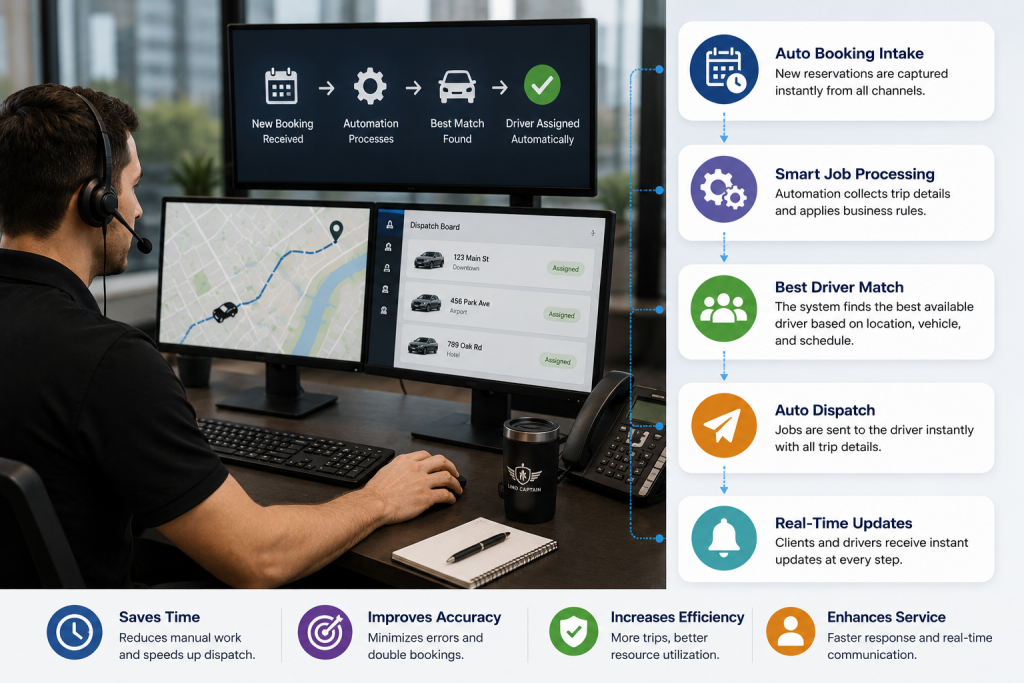
Limo Captain uses automation to give dispatchers more capacity for the decisions that require a person — not to replace the human who defines service quality.
Booking management handles intake automatically — every booking enters the system with trip details, customer details, and pricing applied without manual entry. Automated notifications fire at every stage without dispatcher involvement. The dispatch system gives dispatchers real-time fleet visibility and assignment tools so they make faster, more accurate decisions — managing more bookings with less administrative work, but never removed from the equation.
Frequently Asked Questions
Can AI fully replace a human limo dispatcher?
Not with current technology. AI can automate the repetitive, rules-based parts of dispatch — booking intake, routine driver assignment, notifications, and conflict detection. But AI cannot replicate the contextual judgment, relationship knowledge, and real-time problem solving that define high-quality dispatch for VIP and corporate clients. The appropriate role for AI is augmentation — not replacement.
What is machine learning and how does it apply to dispatch?
Machine learning is a form of AI where computer systems improve performance by learning from data rather than following explicitly programmed rules. In limo dispatch, machine learning applies to demand forecasting, route optimisation, and predictive maintenance. It is particularly valuable for high-volume operational decisions that benefit from pattern recognition across large datasets.
What is natural language processing and can it handle customer bookings?
Natural language processing enables AI to understand and generate human language — powering chatbots that handle booking enquiries, voice assistants for trip requests, and automated email systems. Deep learning significantly improved natural language processing capabilities, and modern AI agents handle standard booking requests competently. Complex, ambiguous, or emotionally sensitive interactions still require a human.
What is the difference between AI and artificial general intelligence?
Current AI systems are Narrow AI — designed for specific tasks and unable to operate outside their domain. Narrow AI processes bookings, optimises routes, and detects conflicts, but cannot reason about novel situations. Artificial General Intelligence — possessing cognitive abilities similar to a human brain — does not yet exist. The AI tools available to limo companies today are powerful for specific tasks but cannot replicate the broad reasoning and judgment of an experienced dispatcher.
What is agentic AI and what could it mean for limo dispatch?
Agentic AI refers to AI agents that autonomously observe, plan, and act to achieve complex goals without human intervention at each step. These systems are emerging in logistics and scheduling — handling multi-step workflows like booking intake, driver assignment, and notification without dispatcher approval at each stage. This is powerful for routine scenarios but introduces new algorithmic bias risks when agents encounter situations their training data did not anticipate.
What is algorithmic bias and why does it matter in dispatch AI?
Algorithmic bias occurs when AI systems produce unfair outcomes because their training data contained human biases. For limo companies, an AI learning from historical dispatch data may encode disparities in service quality across customer segments. Keeping experienced dispatchers in the loop on AI decision making is the most practical safeguard against adverse outcomes that damage client relationships.
What is decision making in AI and how does it compare to human dispatchers?
AI decision making analyzes data against learned patterns to select an action — fundamentally different from human decision making, which integrates experience, emotion, contextual knowledge, and reasoning about consequences. AI enhances decision making for well-defined, data-rich scenarios. Humans make better decisions when information is incomplete or relationship context matters. The best dispatch operations use both: AI for efficiency, humans for contextual judgment.
The Verdict: AI as a Dispatcher’s Tool, Not a Dispatcher’s Replacement
AI tools are already reshaping limo dispatch — automating repetitive tasks, improving route optimisation through machine learning, enabling 24/7 booking through natural language processing, and surfacing performance data instantly. These improvements make dispatchers more effective, not obsolete.
What AI cannot replace is the dispatcher’s ability to reason using knowledge gained from experience, maintain client relationships, and make judgment calls in critical moments. Artificial intelligence AI performs specific tasks within defined parameters — it is not a substitute for the cognitive and relational intelligence premium limo dispatch requires. The limo companies that benefit most from AI are those that use it to give their dispatchers more capacity for the work only humans can do well.
Limo Captain automates the repetitive parts of limo dispatch — booking intake, notifications, scheduling, and reporting — so your dispatcher can focus on the judgment-intensive work that defines your service quality. Book a free demo to see how the platform works.