For any limo business considering whether to develop custom limo software or purchase an existing solution, this is one of the most consequential decisions you will make — and it is one that is misunderstood more often than it is made correctly. Building custom limo software sounds appealing: full control, tailored features, no recurring subscription. But the reality for limo companies in the limo industry is more complicated than that. This guide walks through the build versus buy decision honestly, covering what each path actually delivers, what it costs in time and operational risk, and which approach serves most limo operators best.
What the Build vs Buy Decision Means for a Limo Business
Building custom limo reservation software means commissioning a development team to create a purpose-written platform — covering limo booking software, limousine dispatch software, driver app, payment processing, fleet management, and business performance mentrics — built to your exact specifications. Buying means selecting existing limo software from a provider that has already built, tested, and deployed these functions across hundreds or thousands of limo operators.
The decision affects every aspect of the limo business — how quickly the software is operational, how reliably it performs, how easily it adapts as the business grows, and how the team experiences the daily process of managing bookings, dispatch, and clients. Over 5,400 limo operators globally use integrated limo software rather than custom-built solutions — a number that reflects not a lack of ambition, but a clear-eyed assessment of what actually works in the limo industry.
The Case for Building Custom Limo Software
Complete Control Over Features and Workflows
The most compelling argument for building custom limo software is control — designing every workflow and feature around exactly how your limo business operates. For limo companies with genuinely unique operational models — unusual billing structures, niche service types, or enterprise integrations not available in existing platforms — a custom build may address gaps that off-the-shelf software cannot.
No Licensing Fees or Platform Dependency
A custom-built solution has no ongoing licensing fees and no platform dependency — you own the software, and if the development relationship ends, the code remains with the business. For a limo company that is confident in its long term operational model and willing to invest in owning its own technology infrastructure, this independence has genuine value.
The Real Challenges of Building Custom
Development takes months before the first booking can be made. Every feature that already exists in proven limo booking software — from real time GPS tracking to automated invoicing — has to be built and tested from scratch. Scalable software supports the growth of limousine companies by adapting to increased demand, but achieving that scalability in a custom build requires ongoing development investment as the fleet grows.
Maintenance is a permanent overhead. Bugs need fixing. Payment processing integrations need updating as card networks change. Mobile apps need resubmission as iOS and Android update their requirements. A connected system reduces missed calls and captures more bookings — but building and maintaining that connected system in-house requires either a permanent development team or a reliable long term development partner. For most limo businesses, neither is practical.
The Case for Buying Existing Limo Software
Immediate Access to Proven, Purpose-Built Features
The best limo software available today has already solved the hard problems — real time dispatching improves fleet logistics and efficiency, GPS tracking allows dispatchers to monitor vehicle locations in real time, automated dispatching maximises efficiency and reduces manual errors, and automated invoicing speeds up revenue collection by 45%. These are not theoretical capabilities — they are functions that existing limo software delivers on day one, without months of development or the risk of first-deployment bugs affecting live bookings.
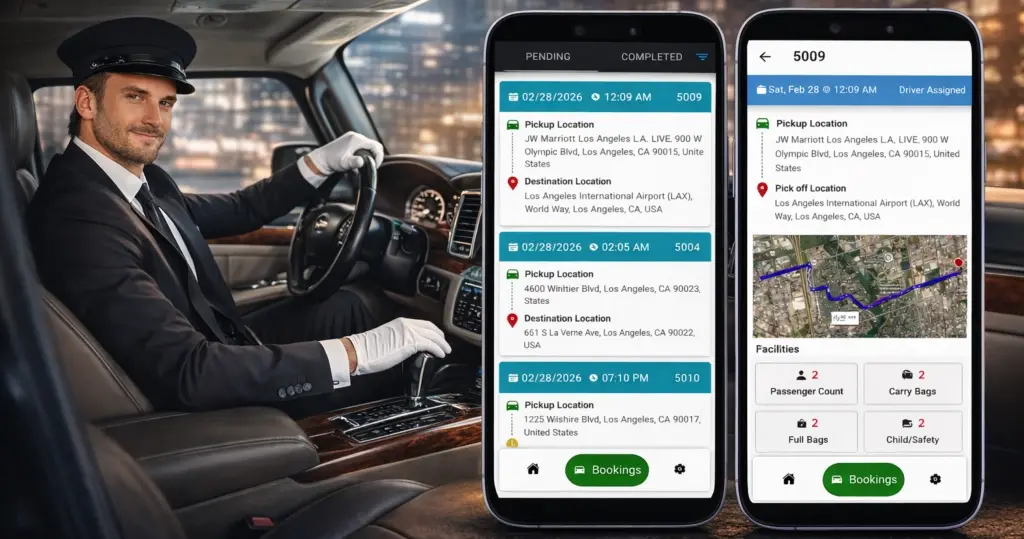
Key features of limo software include real time online booking systems, limo dispatch software that manages ride requests and driver assignments, driver apps that deliver trip details and push notifications, automated payment processing, and reporting and analytics that provide insights into booking trends and driver performance. Building all of these from scratch takes years. Buying them takes days.
Continuous Improvement Without Development Overhead
Established limo software providers continuously release new features — improving the platform based on feedback from thousands of limo operators across the industry. Every improvement in the booking software, dispatch system, or mobile experience is delivered to all users automatically without any development cost to the individual limo business. Integrated limo software can increase online bookings by 2–3x, and online booking capabilities allow customers to book rides anytime from their devices — improvements that come from the provider’s investment in the platform, not the operator’s.
Scalability, Reliability, and Cash Flow Management
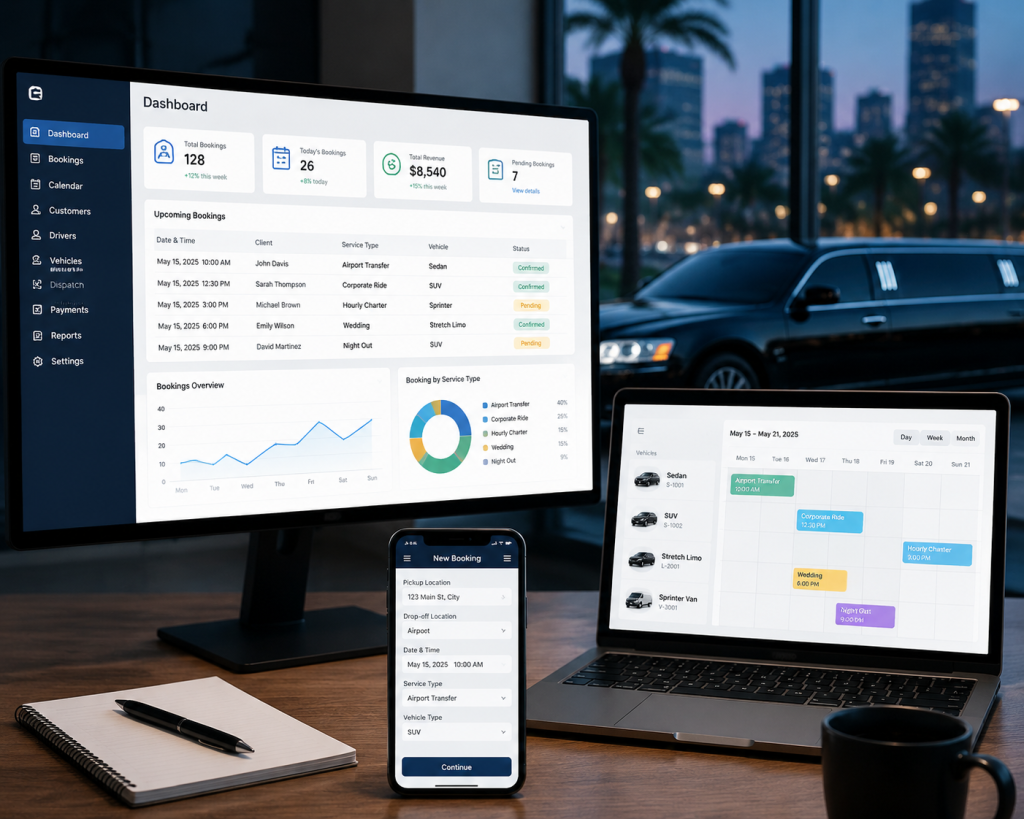
Scalable limo software supports growth by adapting to increased demand — adding vehicles, drivers, and service areas without requiring a new build cycle. Fleet maintenance scheduling is critical for keeping vehicles in safe operating condition, and the best limousine software includes this as a standard feature alongside dispatch management, reservation management, and payment processing. Automated invoicing simplifies financial processes and supports cash flow management — operators can accept payments online, generate invoices automatically, and track outstanding amounts without manual intervention.
Dynamic pricing in limo booking software can adjust rates based on demand and service type, and analytics tools track fleet utilisation and help identify profitability opportunities. These advanced features in existing limo software would require significant additional development time to build — and by the time a custom build delivered them, the market would have moved further forward.
For Most Limo Businesses, Buying Is the Right Decision
The build vs buy decision comes down to one question: does your limo business have a genuinely unique operational requirement that no existing limo software can address? If the answer is no — if your business needs booking, dispatch, payment processing, a driver app, fleet tracking, and reporting — the best limo software already exists. Building instead means months without operational software and features that will always lag behind purpose-built platforms.
A long term partner in limo software grows with the business — releasing improvements, responding to market trends, and supporting the limo business through operational changes without requiring a new build every time the requirements shift. For the vast majority of limo companies, buying the best limo software available is not the shortcut — it is the right answer.
Why Choose Limo Captain as Your Limo Software?
Limo Captain is purpose-built limo software for limo operators — covering limo booking software, limousine dispatch software, driver payroll automation, enterprise customer billing, passenger app, real time GPS tracking, and business analytics in one platform with no hidden fees.
• Limo booking software with passenger app and free booking website for capturing online bookings 24/7
• Limousine dispatch software with real time GPS fleet tracking and route optimisation built in
• Driver payroll automation with geo-location clock-in restrictions — no third party tools needed
• Enterprise billing with consolidated monthly invoicing and custom pricing per corporate account
• Automated notifications, push notifications, and marketing tools as standard features
• No hidden fees and flat pricing that scales from a solo chauffeur to a growing fleet
Limo Captain is deployed and operational in days — not months — giving limo businesses immediate access to every advanced feature they need to manage bookings, dispatch, drivers, and clients from one platform. Book a free demo to see it in action.

Frequently Asked Questions
Is building custom limo software worth it for a limo business?
For most limo businesses, building custom limo software is not worth the time, cost, and operational risk. The best limo software already delivers online booking, limousine dispatch, driver apps, payment processing, GPS tracking, and business analytics — functions that would take months to build from scratch. Over 5,400 limo operators globally use proven integrated limo software rather than custom solutions for exactly this reason.
What is the best limo software for a limo business that wants to book rides fast?
The best limo software for limo businesses that want to book rides fast integrates online booking, automated dispatch, a driver app, and payment processing in one platform. Integrated limo software can increase online bookings by 2–3x, and a connected system reduces missed calls and captures more bookings automatically. The best limousine software allows clients to book rides instantly through the website or passenger app without calling the dispatch system.
How does limo booking software improve cash flow for limo companies?
Limo booking software improves cash flow by automating payment processing at booking, triggering invoicing automatically on trip completion, and generating consolidated monthly invoices for corporate accounts. Automated invoicing speeds up revenue collection by 45%, and integrated payment processing eliminates the manual invoice tracking that delays cash collection. The best limo booking software handles the full payment lifecycle — from booking deposit to final invoice — without manual steps between stages.
What limo dispatch software features matter most for managing the entire fleet?
The most important limo dispatch software features are real time GPS tracking of every active vehicle, automated driver assignment, a driver app delivering trip details and push notifications, and scheduling tools that prevent conflicts. Limo dispatch software manages ride requests and driver assignments in one dispatch system — eliminating the manual communication that creates delays and missed bookings.
How does limousine dispatch software connect booking software and payment processing?
Limousine dispatch software connects booking and payment processing by sharing data in real time. A booking confirmed in the booking software flows into the dispatch system automatically. When the driver completes the trip, billing is triggered and payment processed without manual steps. This connected workflow is what the best limo software delivers as standard — and what takes months to build from scratch.
Build vs Buy: The Decision Is Clearer Than You Think
The best limo software already exists, is purpose-built for the limo business, and is operational within days. Customer relationship management features enable personalised service, mobile apps enhance the user experience for passengers and drivers, and integrations with third party tools streamline operations — all delivered by existing platforms without a custom build.
For limo companies that want to compete on service quality and manage the entire fleet from one platform — buying the best limousine software available delivers results now, not in six months. The best limo software is not a compromise — it is the platform purpose-built to solve the exact problems your limo business faces every day.
Limo Captain is deployed in days, not months — covering booking, dispatch, driver payroll, fleet tracking, and enterprise billing in one platform with no hidden fees. Book a free demo to see why it is the right software for your limo business.
Editorial Note
This blog post was prepared by the Limo Captain Editorial Team in June 2026. Industry statistics referenced are sourced from publicly available research and are included for illustrative context. Limo Captain is the publisher of this content.