A limo business can be profitable, but margins depend on utilisation, operating costs, and pricing. This guide covers what affects profitability and how software helps manage the numbers. It is for operators evaluating the business model or looking to improve an existing operation.
Key Takeaways
- Limo profit margins depend on vehicle utilisation, fuel, insurance, and labour costs.
- Corporate contracts and recurring bookings produce more predictable revenue than one-off events.
- Statistics Canada data shows transportation businesses in the $30K–$5M revenue range posted operating margins around 6 per cent in 2024.
- Toronto Municipal Code Chapter 546 sets licensing and vehicle standards for limousines in the city.
- Good booking software reduces idle time and administrative overhead.
- Call +1 888-545-8881 or visit limocaptain.com.
Do Limo Companies Make Money

Yes, limo companies make money — but not all of them do it consistently. Profitable operators share a few traits: high utilisation, mixed service types, and cost control.
Profitability is not automatic. A limousine sitting idle costs money every day. Insurance, parking, maintenance, and financing continue regardless of whether the vehicle is moving. Every unbooked hour reduces margin.
Those who post consistent profit run full schedules and track cost per trip accurately. Those who struggle undercharge, overborrow on vehicles, or run more vehicles than their bookings support.
Limo Business Profit Margins
Statistics Canada’s data on the transportation sector gives a reference point. Ground transportation businesses in the $30K–$5M revenue range are the reference category. That group posted operating margins of around 6 per cent in 2024. That category includes taxis and limousines combined, so individual limo businesses vary considerably from that figure.
Source: Statistics Canada — Table 20-10-0075-01, Financial data for enterprises, transportation sector.
A 6 per cent margin means keeping roughly $6 from every $100 in revenue. That is not high. Operators who do better than that number have either higher pricing, lower vehicle costs, or both.
Event work — weddings, proms, concerts — tends to carry higher per-hour rates. Corporate contracts carry lower per-hour rates but produce steadier volume. Most profitable fleets run a mix of both.
What Does a Limo Business Owner Make
Owner pay depends on fleet size, service mix, and how the business is structured.
Owner-operators who drive set their pay from what is left after vehicle costs, insurance, and fuel. On a lean schedule, that can mean uneven weekly income. On a full schedule, it can match a solid full-time income.
Owners who manage drivers earn from the margin between trip revenue and operating cost. As the fleet grows, the business increasingly resembles a logistics operation. Administrative load, driver management, and booking volume all increase together.
Owner pay is not a fixed figure. It depends on trip volume, pricing per trip, and how well costs are controlled.
What Affects Limo Business Profitability
Vehicle Utilisation
An idle limousine loses money every hour it sits. High utilisation is the biggest profit driver. Operators who mix corporate contracts with event bookings fill more hours through the week.
Pricing
Underpricing is common in markets with heavy competition. Operators who win bookings by undercutting competitors often find margins too thin to cover unexpected costs. Pricing should reflect vehicle cost, fuel, insurance, driver pay, and a margin for the business.
Insurance Costs
Commercial vehicle insurance for a limousine is a major fixed cost. Toronto Municipal Code Chapter 546 requires at least $2,000,000 in automobile liability coverage per vehicle. That requirement applies to licenced vehicles in Toronto. Insurance premiums vary by vehicle class, driver record, and insurer.
Vehicle Age Rules
Toronto Municipal Code Chapter 546 also sets vehicle age limits for licenced limousines. Sedan-style limousines must not exceed seven model years. Stretch limousines must not exceed eight model years. Operators who hold vehicles beyond those limits risk losing their licence to operate in the city.
The bylaw also permits all-weather tires that meet Transport Canada’s standards.
Fuel and Maintenance
Larger vehicles consume more fuel. Stretch limousines cost significantly more to maintain per kilometre than sedans. Tracking fuel and maintenance per vehicle reveals which vehicles drag on margins.
Driver Costs
Employed drivers add payroll, source deductions, and scheduling complexity. Some operators use subcontractors to cut fixed labour costs, though that affects consistency and control.
How Booking Software Affects Profitability
Administrative work costs money. Every hour on admin tasks is time not spent selling or operating.
Limo service software automates the steps that do not need a human. Dispatch assigns drivers to confirmed bookings automatically. Payment processes at booking. Invoices generate from completed trips without manual work.
The other impact is on utilisation. An online booking page captures reservations around the clock. Customers who find a booking form at 11 pm will complete the reservation. Customers who reach a phone that is not answered often do not call back.
Limo booking software for small fleets covers what to prioritise when choosing a platform.
Limo Captain Plans
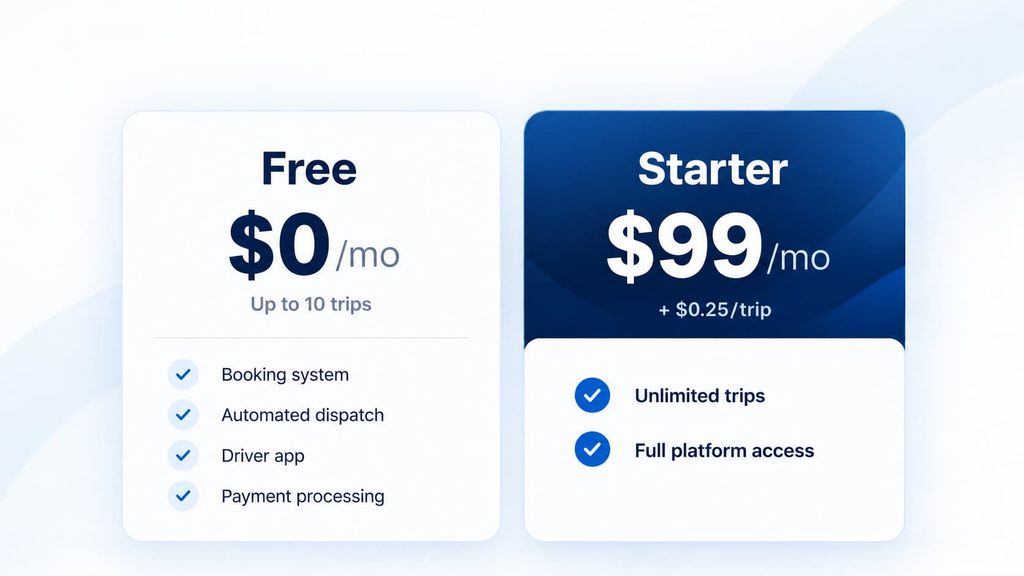
Limo Captain offers two plans suited to different fleet sizes.
The Free plan costs $0 per month and covers up to 10 trips. It includes the booking system, automated dispatch, driver app, and payment processing. It suits operators starting out or running a selective schedule.
The Starter plan is $99 per month plus $0.25 per trip. It removes the trip cap and gives full platform access. Plan details are on the Limo Captain pricing page.
Frequently Asked Questions
Is Owning a Limo Business Worth It
It can be worth it for operators who build a reliable client base and control costs. It is not a passive income model. Vehicles require maintenance, insurance, and active booking management. Operators who treat it as a business rather than a vehicle investment tend to do better.
How Many Trips Does a Limo Need to Break Even
Break-even depends on the cost structure of each operation. Fixed costs include insurance, financing, and parking. Variable costs include fuel and driver pay. Dividing monthly costs by net revenue per trip gives the minimum trip count. Every trip above that point contributes to profit.
What Services Are Most Profitable for a Limo Business
Corporate airport transfers and executive accounts tend to produce consistent volume. Event work — weddings and proms — carries higher per-hour rates. The most profitable operators run both: corporate work fills weekdays and event work fills weekends.
What Software Do Limo Companies Use
Limo companies use limo service software to manage bookings, dispatch, payments, and fleet tracking. Limo Captain is built for limo and chauffeur businesses. The Free plan covers up to 10 trips per month at $0. The Starter plan is $99 per month plus $0.25 per trip.
How Do I Grow a Limo Business
Growth in a limo business comes from adding recurring clients. Corporate accounts generate steady weekly volume. Airport transfer clients often rebook. A reputation for reliability in one service type creates referrals. Executive transfers are a strong starting point.
Get Started with Limo Captain
Limo Captain is purpose-built for limo and chauffeur businesses at every fleet size.
It covers limo booking software — reservations, dispatch, flight tracking, and payment — from one platform. The best limo booking and reservation software guide covers how to evaluate platforms. For operators managing executive accounts, see limo software for corporate transfers.
Call +1 888-545-8881 or visit limocaptain.com to get started.
Editorial Note: This article was prepared by the Limo Captain Editorial Team in August 2026. Statistics Canada figures are referenced for context only. Individual business results vary. Limo Captain is the publisher of this content.