By the Limo Captain Editorial Team | August 2026 | Category: Limo Business Growth | Limo Captain Blog
Farm-Out and Affiliate Networks are best suitable for limo operators and dispatch teams looking for a reliable way to manage overflow bookings while maintaining service quality, visibility, and customer communication. This blog gives you information about how limo operators can handle overflow bookings by using farm-out and affiliate networks without compromising service quality, customer experience, or profitability?
Key Takeaways
• “Farm-out” is a common industry term. Limo Captain refers to this as broker and affiliate operations.
• Broker operations let limo operators fulfil bookings their own fleet cannot cover.
• Affiliate networks generate new clients through commission-based referral arrangements.
• Affiliate marketing is generally performance-based — operators pay only when a booking completes.
• Service quality standards must be set and enforced across all broker and affiliate partners.
• Airport transfers and corporate events create the highest overflow demand for broker arrangements.
• Limo software with dispatch integration makes broker and affiliate operations manageable at scale.
Broker and Affiliate Operations: The Complete Guide for Limo Operators
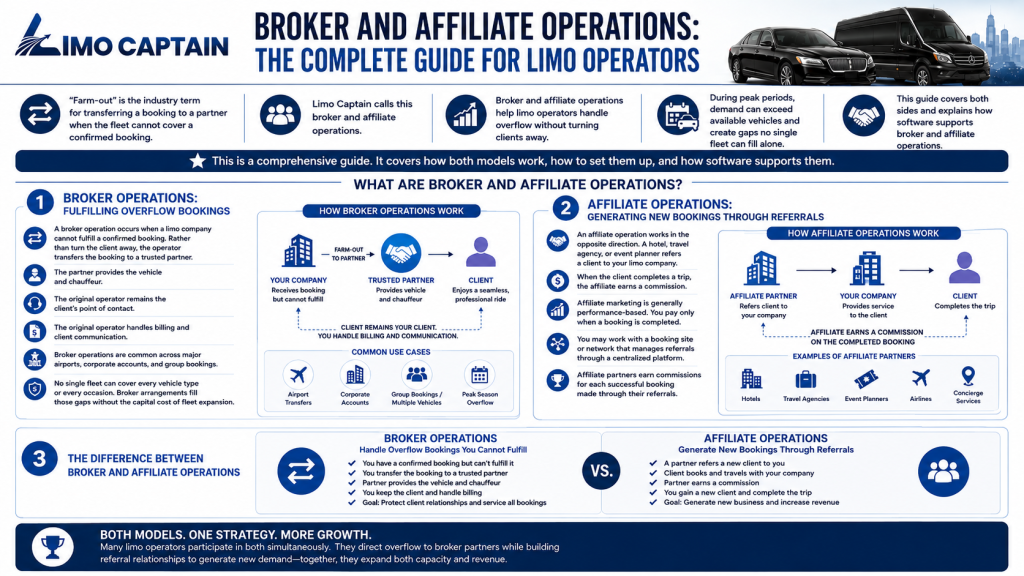
“Farm-out” is the industry term for transferring a booking to a partner. It applies when the fleet cannot cover a confirmed booking. Limo Captain calls this broker and affiliate operations.
Broker and affiliate operations help limo operators handle overflow without turning clients away. During peak periods, demand can exceed available vehicles. Peak periods create gaps no single fleet can fill alone.
This guide covers both sides. Broker operations let you fulfil bookings through trusted partners. Affiliate networks bring new clients through commission-based referrals.
This is a comprehensive guide. It covers how both models work, how to set them up, and how software supports them.
What Are Broker and Affiliate Operations?
Broker Operations: Fulfilling Overflow Bookings
A broker operation occurs when a limo company cannot fulfil a confirmed booking. Rather than cancelling, the operator transfers the booking to a trusted partner. The partner provides the vehicle and chauffeur. The original operator remains the client’s point of contact.
The client experiences a seamless service. They booked with one company and receive a professional ride. The original operator handles billing and client communication. The partner operator handles the trip.
Broker operations are common across major airports, large corporate accounts, and group bookings requiring multiple vehicles. No single fleet can cover every vehicle type for every occasion. Broker arrangements fill those gaps without the capital cost of fleet expansion.
Affiliate Operations: Generating New Bookings Through Referrals
An affiliate operation works in the opposite direction. A hotel, travel agency, or event planner refers a client to your limo company. When the client completes a trip, the affiliate earns a commission.
Affiliate marketing is generally performance-based. You pay only when a booking is completed. This makes affiliate arrangements a low-risk way to generate new business from established referral networks.
An affiliate network connects limo companies with partners who refer clients. The network provides technology for tracking referrals, calculating commissions, and processing payments. Affiliate partners earn commissions for each successful booking made through their referrals.
The Difference Between Broker and Affiliate Operations
Broker operations handle overflow — a booking you cannot fulfil, transferred to a partner. Affiliate operations generate new bookings — a partner refers a client who books with you.
Many limo operators participate in both simultaneously. They direct overflow to broker partners while building affiliate relationships. Together, the two models expand both capacity and revenue.
How Broker Operations Work in the Limo Industry
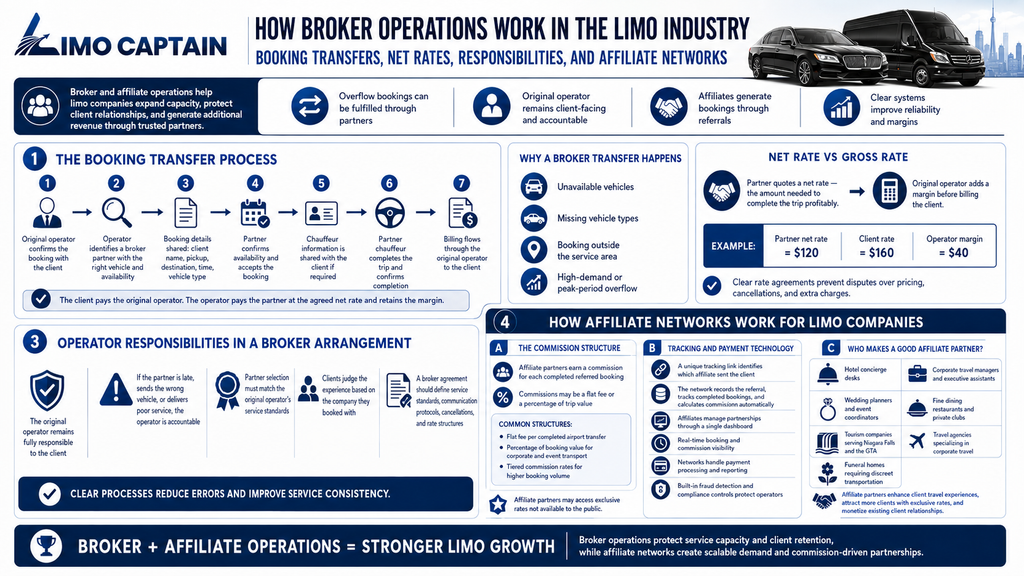
The Booking Transfer Process
A broker operation begins when a limo company cannot cover a booking. It may be unavailable vehicles, missing vehicle types, or a location outside the service area.
The process follows a clear sequence:
• The original operator confirms the booking with the client as normal
• Internally, the operator identifies a broker partner with the right vehicle and availability
• Booking details shared: client name, pickup location, destination, time, and vehicle type
• The partner confirms availability and accepts the booking
• Chauffeur information is shared with the client if required by the operator’s service standards
• The partner’s chauffeur completes the trip and confirms completion
• Billing flows through the original operator to the client
The client pays the original operator. The operator pays the partner at the agreed net rate. The operator retains the margin between the client rate and the partner rate.
Net Rate vs Gross Rate in Broker Arrangements
Broker operations typically use a net rate structure. The partner operator quotes a net rate — what they need to complete the trip profitably. The original operator adds their margin on top when billing the client.
If a partner charges $120 net and the client pays $160, the $40 covers overhead.
Both parties agree on the net rate before the booking is transferred. Clear agreements prevent disputes over rates, cancellations, and additional charges.
Operator Responsibilities in a Broker Arrangement
The original operator retains full responsibility to the client in a broker arrangement. If the partner fails with late arrival, wrong vehicle, or poor service, the operator is accountable.
This makes partner selection critical. Broker arrangements only work when the partner’s service quality matches the original operator’s standards. The client does not know about the arrangement. They evaluate the experience based on the company they booked with.
Clear processes reduce errors and improve service delivery consistency. A broker agreement covers service standards, cancellation procedures, communication protocols, and rate structures.
How Affiliate Networks Work for Limo Companies
The Commission Structure
Affiliate partners earn a commission for every booking they refer that results in a completed trip. The commission can be a flat fee per booking or a percentage of the trip value.
Common affiliate commission structures in the limo industry include:
• Flat fee per completed airport transfer — simple for hotel concierge desks to understand
• Percentage of booking value for corporate accounts and event transport — scales with trip value
• Tiered commission rates that increase as the affiliate refers more bookings in a given period
Affiliate partners access exclusive rates not available to the public. Affiliates can offer clients a better rate through the hotel or agency than booking directly.
Tracking and Payment Technology
Affiliate networks provide technology for tracking referrals and calculating commissions. A unique tracking link identifies which affiliate sent a client to the booking process. The affiliate network records the referral, tracks the completed booking, and calculates the commission automatically.
Affiliates manage multiple partnerships through a single dashboard. They track bookings and commissions in real time. Affiliate networks handle payment processing and reporting — keeping commissions accurate and timely.
Affiliate networks offer built-in fraud detection and compliance controls. This protects operators from inflated referral claims.
Who Makes a Good Affiliate Partner?
Effective affiliate partners reach audiences who regularly need premium transportation services. The best affiliate partners for limo companies include:
• Hotel concierge desks in downtown Toronto, Richmond Hill, and major business districts
• Corporate travel managers and executive assistants who book ground transport for executives
• Wedding planners and event coordinators managing venue transport for large events
• Fine dining restaurants and private clubs with regular clientele needing chauffeur service
• Tourism companies offering packages to Niagara Falls and the Greater Toronto Area
• Travel agencies specializing in corporate travel and business class bookings
• Funeral homes requiring professional, discreet ground transportation services
Affiliates can enhance client travel experiences with premium services. Exclusive rates help affiliates attract more clients seeking quality transportation. The program allows partners to monetize their existing client relationships effectively.
Setting Up Broker Relationships: A Step-by-Step Approach
Vetting Broker Partner Operators
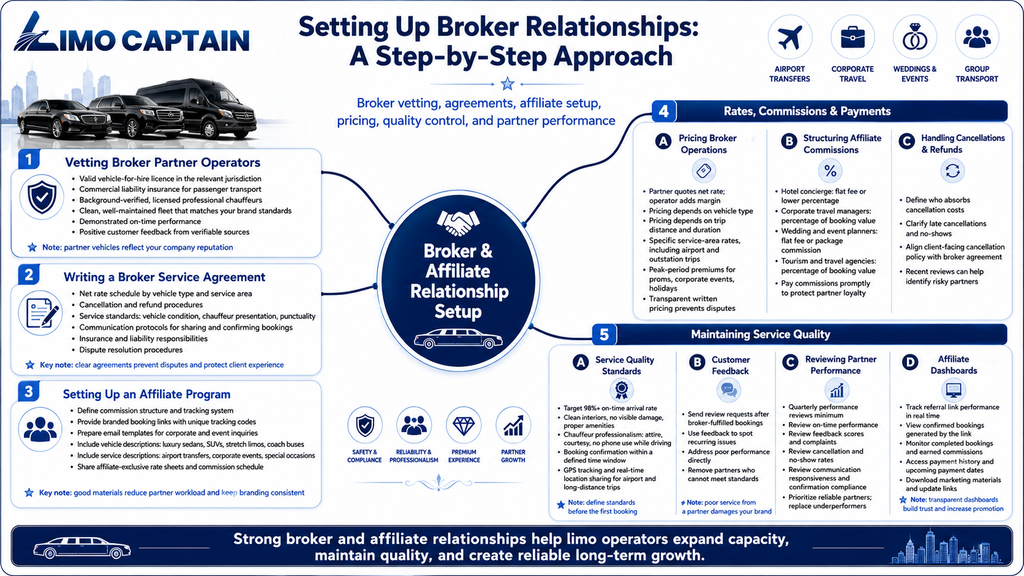
Not every limo company is an appropriate broker partner. Before transferring a booking, operators should verify the partner meets minimum standards:
• Valid commercial vehicle-for-hire licence in the relevant jurisdiction
• Adequate commercial liability insurance covering passenger transport
• Background-verified, licensed professional chauffeurs
• Fleet vehicles that meet your service quality standards for condition and cleanliness
• Demonstrated on-time performance record
• Consistent positive customer feedback from verifiable sources
Companies should provide proof of commercial liability insurance before any booking is transferred. Clients should inspect vehicle cleanliness and condition before boarding. Your broker partner’s vehicles reflect on your company’s reputation.
Writing a Broker Service Agreement
Every broker relationship should be documented in writing before the first booking transfers. A broker agreement should cover:
• Net rate schedule for each vehicle type and service area
• Cancellation and refund procedures for transferred bookings
• Service standard requirements — vehicle condition, chauffeur presentation, on-time performance targets
• Communication protocols — how booking details are shared and confirmed
• Insurance and liability responsibilities for each party
• Dispute resolution procedures for service failures
It is crucial to understand cancellation and refund policies before formalizing any broker arrangement. Clear agreements prevent the disputes that damage both the partner relationship and the client experience.
Setting Up an Affiliate Program
An affiliate program requires defined commission structures, materials, and a tracking system before launch.
Affiliates receive marketing materials to promote services. Prepare materials that reflect your brand standards. These should include:
• Branded booking links with unique tracking codes per affiliate
• Email templates for corporate clients and event enquiries
• Vehicle descriptions — luxury sedans, spacious SUVs, stretch limos, coach buses
• Service descriptions covering airport transfers, corporate events, and special occasions
• Affiliate-exclusive rate sheets and commission schedule documentation
Good affiliate materials reduce the work partners must do to refer clients. They also ensure consistent brand representation across all affiliate channels.
Rates, Commissions, and Payment Structures
Pricing Broker Operations
Broker operations work on net rates. The partner quotes what they need. The original operator adds their margin. Both parties agree on rates before any booking transfers.
Common considerations when setting broker net rates:
• Vehicle type — sedans, SUVs, and stretch vehicles command different rates
• Trip distance and duration — transfers, hourly, and outstation trips each have distinct cost bases
• Service area — Toronto Pearson and outstation trips require specific rate agreements
• Peak period premiums — high-demand dates such as proms, corporate events, and holiday periods
Transparent pricing includes all fees and charges in writing. Rate disputes are the most common point of friction in broker arrangements. A detailed written rate schedule prevents them.
Structuring Affiliate Commissions
Affiliate commissions should be competitive enough to motivate partners but sustainable for the limo business. Industry affiliate commission arrangements typically reflect the value of the referral source:
• Hotel concierge referrals: flat fee or lower percentage — high volume, lower-value individual trips
• Corporate travel managers: percentage of booking value — high-value, recurring corporate accounts
• Wedding and event planners: flat fee or package commission — specialized, high-value bookings
• Tourism and travel agencies: percentage of booking value — mix of individual and group bookings
Commissions should be paid promptly on completed bookings. Delayed payments erode affiliate partner loyalty and can reduce referral volume over time.
Handling Cancellations and Refunds in Broker Arrangements
Cancellations are more complex in broker arrangements than in direct bookings. Two companies are involved. Both may incur costs when a client cancels. The broker agreement must specify:
• Which party absorbs the cancellation cost when a client cancels within the agreed window
• How late cancellations and no-shows are handled between the original operator and the broker partner
• What the client-facing cancellation policy states and how it aligns with the broker agreement
Checking recent reviews can help limo operators evaluate potential broker partners before formalizing an arrangement. A partner with a pattern of cancellations creates operational risk.
Maintaining Service Quality Across Broker and Affiliate Partners
Setting Service Quality Standards
Service quality is measured by reliability, responsiveness, and assurance. Every broker partner must meet defined benchmarks before a booking is transferred to them.
Minimum service quality standards for broker partners should include:
• On-time arrival rate target — luxury transport should target 98% or higher
• Vehicle presentation standards — clean interior, no visible damage, appropriate amenities
• Chauffeur professional standards — appropriate attire, courteous conduct, no mobile phone use while driving
• Communication standards — confirmation of booking receipt within a defined time window
• GPS tracking and real-time location sharing for airport and long-distance bookings
Defining quality standards prevents misunderstandings. Document standards and share them with every broker partner before the first booking.
Collecting and Acting on Customer Feedback
Collecting customer feedback regularly enhances service quality improvements across the broker network. After every booking fulfilled by a broker partner, send a review request to the client.
Customer feedback reveals patterns that internal reviews miss. If a specific broker partner consistently receives poor feedback, address it directly. Set a defined performance improvement timeline. Remove partners who cannot maintain the required standard.
Service quality impacts an organization’s reputation and profitability. A poor experience delivered by a broker partner damages your brand — not theirs.
Reviewing Partner Performance
Schedule regular partner performance reviews. Quarterly reviews for active broker partners are a practical minimum. Each review should cover:
• On-time performance over the review period
• Customer feedback scores and complaints relating to that partner
• Cancellation and no-show rates for transferred bookings
• Communication responsiveness and booking confirmation compliance
• Any service standard violations and how they were resolved
Reliable service delivery meets customer expectations consistently. Partners who demonstrate consistent reliability deserve priority when overflow bookings arise. Partners who consistently underperform should be replaced.
Affiliate Tracking and Commission Dashboards
Affiliates can manage multiple partnerships through a single dashboard. A good affiliate platform allows partners to:
• Track their referral link performance in real time
• View confirmed bookings generated through their link
• Monitor completed bookings and earned commissions
• Access commission payment history and upcoming payment dates
• Download marketing materials and update their booking links
Transparent affiliate dashboards build partner trust. Partners who see their commissions clearly are more likely to promote services actively.
Broker and Affiliate Operations in the Canadian Limo Market
Airport Transfer Overflow in Toronto
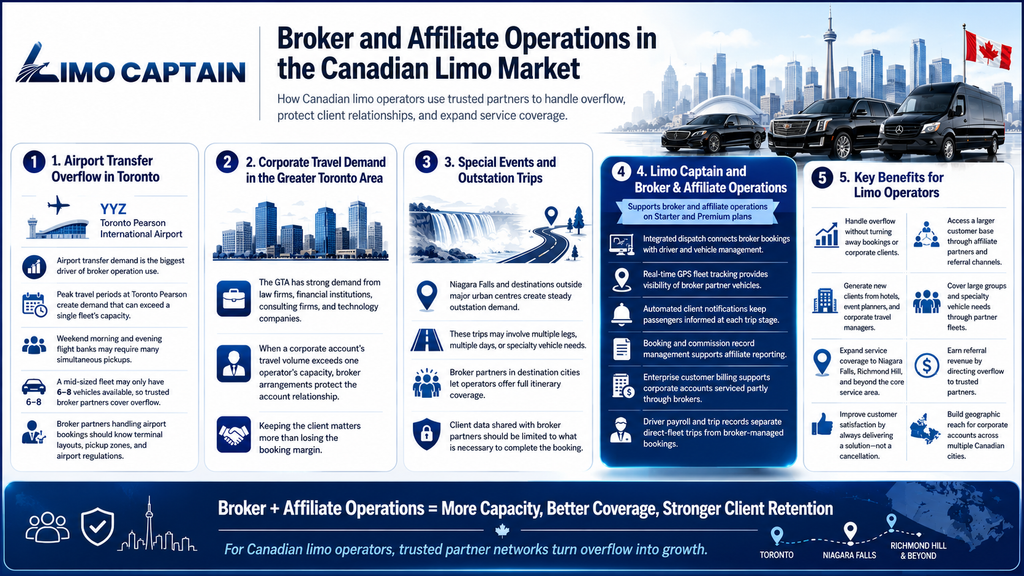
Airport transfer demand is the largest driver of broker operation use in the Canadian limo market.
Toronto Pearson International Airport (YYZ) is one of Canada’s busiest aviation hubs, (Toronto Pearson International Airport) handling tens of millions of passengers annually. Peak travel periods create demand that regularly exceeds individual operator capacity.
Weekend morning and evening flight banks at Toronto Pearson can require dozens of simultaneous airport pickups. A mid-sized limo fleet may have six or eight vehicles available. Broker arrangements with trusted partners cover the overflow without leaving clients stranded.
Meet-and-greet airport services enhance the transfer experience. Broker partners handling airport bookings should know Pearson’s terminal layout, pickup locations, and applicable regulations.
Corporate Travel Demand in the Greater Toronto Area
The Greater Toronto Area supports a large corporate travel market. Law firms, financial institutions, consulting firms, and technology companies regularly require executive ground transportation.
When a corporate account’s travel volume exceeds one operator’s capacity, broker arrangements protect the account relationship.
Losing a corporate account due to unavailability costs far more than the broker margin. Broker operations protect the client relationship and keep revenue within the business.
Special Events and Outstation Trips
Niagara Falls and other destinations outside major urban centres generate consistent outstation demand. These trips often require vehicles for multiple legs over multiple days.
Broker partners in destination cities allow limo operators to offer complete itinerary coverage. This turns a single-city operator into a full-service provider for clients with complex travel needs.
For limo operators handling bookings that involve sharing client data with broker partners, Canada’s Privacy Commissioner provides guidance on commercial data practices. Client data shared with broker partners should be limited to what is necessary to complete the specific booking.
Limo Captain and Broker & Affiliate Operations
Limo Captain supports broker and affiliate operations on Starter and Premium plans with exceptional service quality.
The Limo Captain’s user-friendly platform supports broker and affiliate operations through:
• Integrated dispatch that connects broker bookings to the platform’s driver and vehicle management
• Real-time GPS fleet tracking for visibility of broker partner vehicles during transferred bookings
• Automated client notifications at each trip stage — regardless of which fleet completes the trip
• Booking and commission record management for affiliate partner reporting
• Enterprise customer billing that supports corporate accounts serviced partially through broker arrangements
• Driver payroll and trip records that separate direct fleet trips from broker-managed bookings
Key Benefits of Broker and Affiliate Operations for Limo Operators
Operators who build strong broker and affiliate networks gain measurable advantages:
• Handle overflow without turning away bookings or corporate clients
• Access a larger customer base through affiliate partners and referral channels
• Generate new clients from hotels, event planners, and corporate travel managers
• Cover large groups and specialty vehicle needs through partner fleets
• Expand service coverage to Niagara Falls, Richmond Hill, and destinations beyond the core service area
• Earn referral commission revenue by directing overflow to trusted broker partners
• Improve customer satisfaction by always delivering a solution — not a cancellation
• Build geographic reach for corporate accounts that travel across multiple Canadian cities
Frequently Asked Questions
What Is the Difference Between Broker Operations and Affiliate Networks in the Limo Industry?
Broker operations occur when a limo operator transfers a booking because the fleet cannot cover it. Affiliate networks work in reverse — a partner refers new clients in exchange for a commission. Many limo operators participate in both to expand capacity and revenue.
How Do Affiliate Partners Earn Commissions for Limo Bookings?
Affiliate partners earn commissions through unique tracking links. When a client completes a trip through the link, the network calculates and records the commission. Affiliates track bookings and commissions through a real-time dashboard. The program provides marketing materials — booking links, vehicle descriptions, and service information.
How Do Limo Operators Maintain Service Quality Across Broker Partners?
Limo operators maintain quality across broker partners by setting documented standards before any booking is transferred. Standards should cover vehicle condition, chauffeur presentation, on-time targets, and communication protocols. Collect client feedback after every broker booking. Review partner performance quarterly. Replace partners who cannot maintain the required standard.
What Types of Bookings Are Best Suited for Broker Operations?
Airport transfers, corporate events, large group bookings, and outstation trips suit broker operations well. Toronto Pearson transfers during peak periods are the most common example. Any booking exceeding fleet capacity is a candidate for a broker arrangement.
How Does Broker and Affiliate Management Work in Limo Software?
Limo software with broker and affiliate support connects transfers, dispatch, tracking, and billing in one platform. When a booking transfers, the dispatch system records it, tracks the trip, and sends client notifications. Commission tracking records referrals, calculates amounts, and processes payments. This eliminates manual steps that create errors at scale.
Broker and Affiliate Operations: A Growth Strategy, Not Just an Overflow Fix
Broker and affiliate operations are more than a contingency plan. When managed properly, they are a growth strategy. Broker arrangements allow a limo operator to serve every booking regardless of fleet size. Affiliate networks turn existing business relationships into a sustainable referral engine.
The key to making both work is structure. Written agreements, documented standards, and consistent partner reviews turn informal arrangements into reliable business infrastructure. This creates a competitive advantage that fleet-only operators cannot easily match.
Providing High quality service is the foundation. A poorly handled booking reflects on the original operator. An affiliate partner who refers clients to a bad experience stops referring. Both models succeed only when every client gets the same professional service. Regardless of which vehicle completes the trip.
Limo Captain supports limousine service brokers and affiliate operations — dispatch, tracking, notifications, and commission management.
Grow your network and handle overflow without losing service quality.
📞 Call us today: +1 888-545-8881